Thursday, November 17, 2005
Supernanny style family analysis will become compulsory
Or at least it should. So many family problems that end up being family breakers or worse, can be nipped in the bud by a few weeks of analysis and training of the parents by experienced "nannies". The excerpts from the show seem extreme, but they are extremely common problems. Each family is a special case, and all parents have gaps in the understanding of the potential solutions. This is why watching the show isn't really enough. The three week program just has to be gone through for maximal society benefit.


Wednesday, November 16, 2005
Tuesday, November 15, 2005
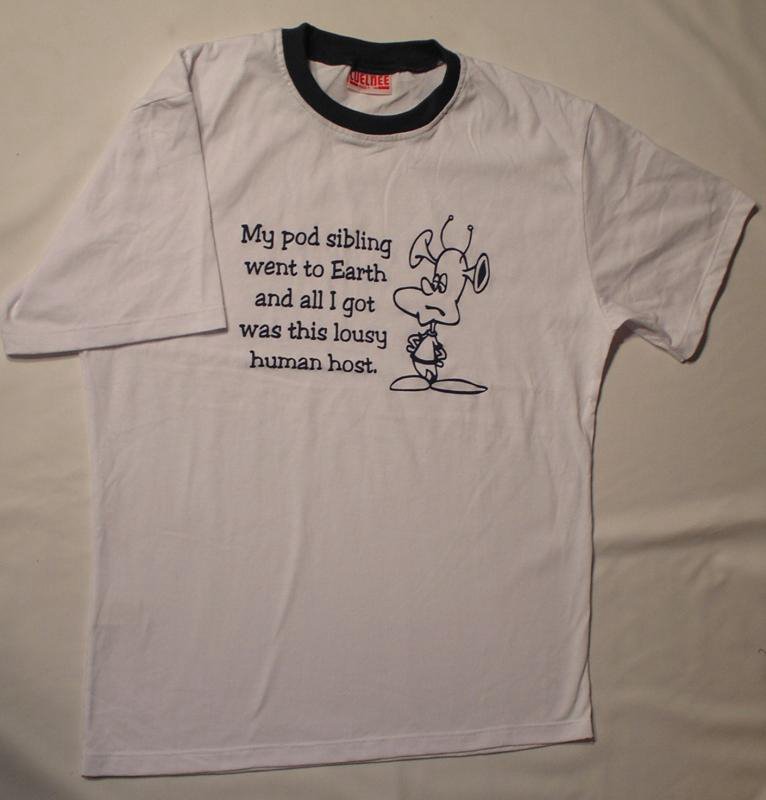
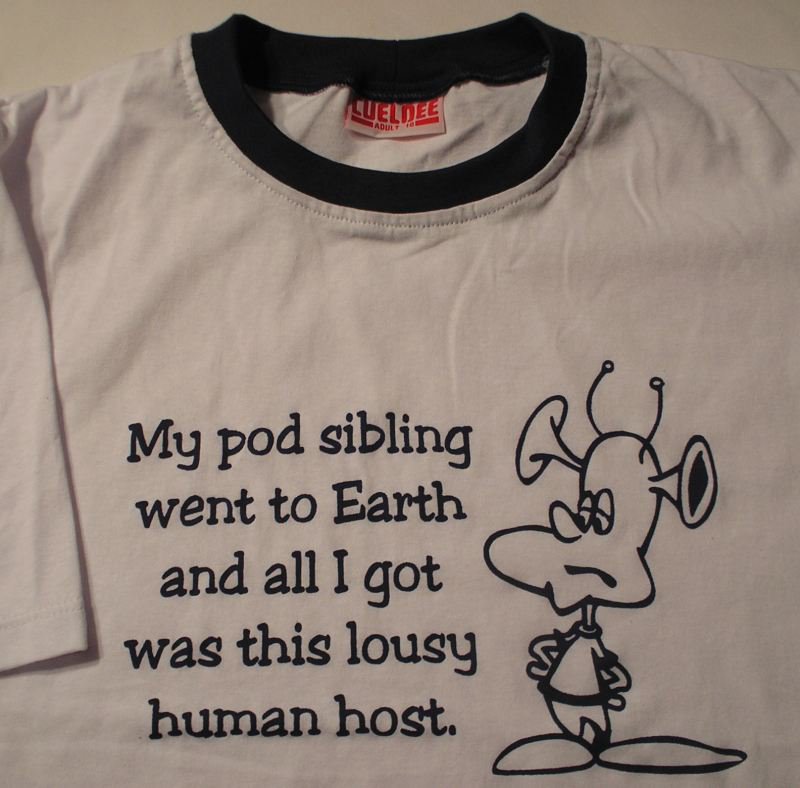
My pod-sibling went to Earth and all I got was this lousy human host
I have managed to manufacture 30 of these in sizes M to XXL, and I will be posting them on ebay on THIS LINK. Some will be on auction, some at fixed price (maybe $15) any remaining will still be auctioned before Christmas (My guess is that the last ones may end up fetching the most)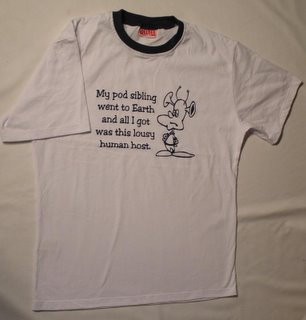

Thursday, November 10, 2005
The problem with invisible hand arguments
There is of course Adam Smith's invisible hand, but I believe in a rather larger number of them than the one associated with "greed is good" in relation to money. In the political sphere, if you translate money to votes one can imagine the invisible hand of democracy ensuring a country's well being, where even a well-meaning dictator, Pope or whatever cannot self-adjust to changing political, cultural and economic landscapes.
The real problem with promoting invisible hands as a "fact" as opposed to "unproven theory" is that, like black holes, dark matter and truthful politicians is that they are invisible. One can only look at the indirect effects and claim them as due to economic structure rather than direct visible action by a particular entity. Just as I grudgingly think that we should take the cosmologists word as to the existence of black holes because they are the experts; we should trust the economists when their studies show that lower awards, zero tariffs, less red tape etc. etc. are good for the country as a whole, and the compensation for those that may lose is cheaper than the cost of not making these changes.
The real problem with promoting invisible hands as a "fact" as opposed to "unproven theory" is that, like black holes, dark matter and truthful politicians is that they are invisible. One can only look at the indirect effects and claim them as due to economic structure rather than direct visible action by a particular entity. Just as I grudgingly think that we should take the cosmologists word as to the existence of black holes because they are the experts; we should trust the economists when their studies show that lower awards, zero tariffs, less red tape etc. etc. are good for the country as a whole, and the compensation for those that may lose is cheaper than the cost of not making these changes.
Monday, November 07, 2005
The market is our guarantee
Do I really need a law to state that bread must be always available at every corner shop, that it be priced under $2.00 a loaf, and that it has to taste good? By rejecting bread (and sometimes all products from a particular shop) when a) It is more expensive than you’re willing to pay ; b) If they never seem to have the bread you want left or c) the bread is not nice in one way or another – we are acting as agents enforcing an implicit guarantee that we are getting acceptable value for money. * a statement saying that bread sellers should not overcharge is absolving ourselves of responsibility to keep them honest *
Why have a government agency to enforce bread standards when we are perfectly capable, as individual consumers, to in our own way dictate the standard by what we choose to buy. Poor quality, service or overpricing can still legally happen, but more efficiently adjusts to market pressure, than it could by direct mandates.
Similarly, do we need a law that states what hours you are allowed to work, that it must be at least a certain amount per hour, and that it should be fulfilling? All these criteria are important both for an employee and an employer, but by denying flexibility in the first two distorts the market mechanisms for all three. Different employees will have different priorities between remuneration, hours that can be worked and overall fulfilment in the job. Countries with price controls on bread end up having all bread at the same maximum allowed cost, not being readily available, and generally having dubious quality and no variety of choice. The free market in bread doesn’t necessarily make bread cheaper, but makes suppliers of bread compete to find breads that people will pay a high price for, while consumers will compete to find cheap but good quality breads.
A freer market in jobs will make employees and employers reputations much more important. Power will move from large unions and big companies to agencies, individuals, contractors, small employee groupings and nimble small businesses. The main difference to be seen will be a rise in the importance of job fulfilment over the letter of the industrial relations laws. The guarantees explicit in most awards are also guaranteeing that job fulfilment is a lower priority for employers than getting a reasonable fit in the costs and hours allowable.
Although large unions will lose a great deal of their power and influence, smaller unions and alternative worker groupings may actually have more clout by being able to favour certain employers over others for a range of tangible or intangible offerings.
Why have a government agency to enforce bread standards when we are perfectly capable, as individual consumers, to in our own way dictate the standard by what we choose to buy. Poor quality, service or overpricing can still legally happen, but more efficiently adjusts to market pressure, than it could by direct mandates.
Similarly, do we need a law that states what hours you are allowed to work, that it must be at least a certain amount per hour, and that it should be fulfilling? All these criteria are important both for an employee and an employer, but by denying flexibility in the first two distorts the market mechanisms for all three. Different employees will have different priorities between remuneration, hours that can be worked and overall fulfilment in the job. Countries with price controls on bread end up having all bread at the same maximum allowed cost, not being readily available, and generally having dubious quality and no variety of choice. The free market in bread doesn’t necessarily make bread cheaper, but makes suppliers of bread compete to find breads that people will pay a high price for, while consumers will compete to find cheap but good quality breads.
A freer market in jobs will make employees and employers reputations much more important. Power will move from large unions and big companies to agencies, individuals, contractors, small employee groupings and nimble small businesses. The main difference to be seen will be a rise in the importance of job fulfilment over the letter of the industrial relations laws. The guarantees explicit in most awards are also guaranteeing that job fulfilment is a lower priority for employers than getting a reasonable fit in the costs and hours allowable.
Although large unions will lose a great deal of their power and influence, smaller unions and alternative worker groupings may actually have more clout by being able to favour certain employers over others for a range of tangible or intangible offerings.
Monday, October 31, 2005
If you quote someone on your weblog, they may find you!
This has happened to me. Appropriately with the Industrial relations changes happening in parliament, this person is a champion of the working mother. She has worked tirelessly to improve the lives of lower socio-economic disadvantaged recent migrants. She has done it by attacking certain unhelpful law provisions that were proposed. Ironically, she is now being made to work up to 18 hours a day by her employer just to try to make a better life for her children. The system that allows this to happen is not being challenged......
Her employer is of course *herself* - The system that allows unlimited work hours is *EBAY*, the unhelpful law provisions she was attacking was the "fairwear" ones, which I also attacked - and migrants from a lower socio-economic status often have industrial sewing skills, children, and are perfect for helping out our sewer shortage, if only they were "free" to work from home, where they could be with their children. Vanthida Lao - You are a champion. Stop by my weblog anytime.
Her employer is of course *herself* - The system that allows unlimited work hours is *EBAY*, the unhelpful law provisions she was attacking was the "fairwear" ones, which I also attacked - and migrants from a lower socio-economic status often have industrial sewing skills, children, and are perfect for helping out our sewer shortage, if only they were "free" to work from home, where they could be with their children. Vanthida Lao - You are a champion. Stop by my weblog anytime.
Wednesday, October 26, 2005
Evolution as a ladder
The entire evolution vs special creation debate as I have researched it, has been completely hijacked by people who refer indirectly to evolution as a ladder with amoebas (or whatever) at the bottom and humans at the top. Creationists arguments often centre on there being "missing links" (on the chain from bottom to top) , that the transformation from random jumbles of molecules to sentient beings breaks fundamental laws of entropy in a natural process. On the other side of the argument, David Attenborough's "Life on Earth" show moved episode by episode up the ladder. Even Carl Sagan's "Cosmos" (ok. these are 80's shows but I haven't seen much change) had one episode where they were calculating the approximate probability of life on other planets - by calculating the probability of life moving up the ladder of creation to sentient beings.
Wednesday, October 19, 2005
Role of the catholic church
This Economist article has an interesting slant on the pope's reign and the church's future direction. However because it focuses on foreseeable consequences of policy, rather than moral principles of right and wrong: to be kind, the economist is showing fairly extreme moral contextualism - hinting that contraception and abortion policy may have to be more liberal in some contexts for the greater good of the world.
Tuesday, October 18, 2005
Kashmir
I had commented sometime last year that I was not confident of a solution in Kashmir for peace without some serious bloodshed. I also commented how the Tsunami in Aceh had improved the prospects for long term peace there. I suspect the inevitable international relief effort due to the earthquake in the disputed areas would improve the chances of successful mediation leading to possible compromises. The bloodshed has basically already happened now.
Thursday, October 06, 2005
Why am I mysteriously confident in ethanol?
It's not the technology - there has been no breakthrough in the burning of ethanol in an internal combustion engine.
It's not the economics. Even if the current high oil prices are prolonged, the economics of bio-ethanol is still marginal.(Although the future is hard to predict in this regard)
It's not the environment - I would be happy if we exclusively used fossil fuels until we had to mine Mars (Earth first! We'll strip mine the other planets later)
My reasoning is entirely "evolutionary". There is clearly going to be fragmentation of the fuel market as fossil-based fuels becomes less and less convenient over time. Which fuels become somewhat successful will depend on how we get from "here" to "there" - "Here" being little or no economies of scale to "There" being generally available at service stations. This is where ethanol is advantageous - Due to the economies of scale developed by Brazil (a huge loss making venture by its government so far) there is good availability of flex-fuel engines and ethanol producing capacity. Add in the fact that blends can be adapted to take advantage of price differentials between oil, ethanol and sugar, and ethanol blends can be increased when the price of oil is high, decreased again if need be, self regulated by the market, temporary shocks in oil price changes can be spread out to a few other commodities at the very least, and if oil becomes scarce permanently the market will allow for 100% ethanol to overtake fossil fuels.
It's not the economics. Even if the current high oil prices are prolonged, the economics of bio-ethanol is still marginal.(Although the future is hard to predict in this regard)
It's not the environment - I would be happy if we exclusively used fossil fuels until we had to mine Mars (Earth first! We'll strip mine the other planets later)
My reasoning is entirely "evolutionary". There is clearly going to be fragmentation of the fuel market as fossil-based fuels becomes less and less convenient over time. Which fuels become somewhat successful will depend on how we get from "here" to "there" - "Here" being little or no economies of scale to "There" being generally available at service stations. This is where ethanol is advantageous - Due to the economies of scale developed by Brazil (a huge loss making venture by its government so far) there is good availability of flex-fuel engines and ethanol producing capacity. Add in the fact that blends can be adapted to take advantage of price differentials between oil, ethanol and sugar, and ethanol blends can be increased when the price of oil is high, decreased again if need be, self regulated by the market, temporary shocks in oil price changes can be spread out to a few other commodities at the very least, and if oil becomes scarce permanently the market will allow for 100% ethanol to overtake fossil fuels.
Thursday, September 29, 2005
Australia's lost ethanol opportunity
A couple of years ago, there was a plan to introduce broad scale ethanol blended fuel Australia wide. The plan hit a hiccup because there was just not enough domestic industrial production of ethanol in Aus. One avenue open was to import ethanol from Brazil as a stopgap until such time as local production could increase. However the (local) sugarcane lobby was feared by the government and the whole project got put in the back-burner. Because blended fuel then became a niche, car problems started being blamed on ethanol. This would not have happened if we had started to import heavily from Brazil. The sugar price may well have increased with the extra demand from cars, helping our farmers. We could be importing ethanol technologies while exporting sugar cane technologies.
Saturday, September 24, 2005
Why evacuate Houston?
I know the saying once bitten twice shy, but it made sense to me for Darwin to be completely evacuated *after* Cyclone Tracey struck, and I agree that New Orleans ideally would have been completely evacuated *before* Katrina - but Houston is almost all above sea level, so floods may come, but they would quickly go. It would be a lot easier to manage if most people stayed holed up in their homes, and just higher risk areas evacuated - such as Galveston, low lying suburbs and perhaps those exposed coastal areas. I know there is high labour mobility in USA - but such a sudden dispersal of huge numbers of people would have a negative impact on the economy.
Friday, September 16, 2005
Katrina again
Dr. Clam said...
You can't avoid (3) without tearing up the Constitution and jumping up and down on the pieces. The United States still operates on a Federal system, to a much greater extent than Australia, and the states concerned in particular have a long tradition of telling the Federal government to bugger off and leave them alone, to the extent of being reduced to rubble over it. Normally this decentralisation of power is a good thing: in this particular case it was a bad thing. But a counterfactual that says 'don't inolve the states' is as silly as a counterfactual that says 'send in the cloned super-soldier penguins to rescue survivors'.
This is the whole point of "State of Emergency". Emergency powers have been abused in some countries, it's true; however, surely there are provisions for it in the US constitution. Levee breach in New Orleans = temporary suspension of decentralisation of power, just as I would hope it would have been had Cyclone Katrina hit us after Sid.
Incidentally, I have seen research regarding storm surges, and the figure was, any particular point on the tropical East coast of Aus gets a storm surge of average 4 m once in every three hundred years, based on geological time scales.
You can't avoid (3) without tearing up the Constitution and jumping up and down on the pieces. The United States still operates on a Federal system, to a much greater extent than Australia, and the states concerned in particular have a long tradition of telling the Federal government to bugger off and leave them alone, to the extent of being reduced to rubble over it. Normally this decentralisation of power is a good thing: in this particular case it was a bad thing. But a counterfactual that says 'don't inolve the states' is as silly as a counterfactual that says 'send in the cloned super-soldier penguins to rescue survivors'.
This is the whole point of "State of Emergency". Emergency powers have been abused in some countries, it's true; however, surely there are provisions for it in the US constitution. Levee breach in New Orleans = temporary suspension of decentralisation of power, just as I would hope it would have been had Cyclone Katrina hit us after Sid.
Incidentally, I have seen research regarding storm surges, and the figure was, any particular point on the tropical East coast of Aus gets a storm surge of average 4 m once in every three hundred years, based on geological time scales.
Wednesday, September 14, 2005
Why the Katrina response was wrong
The response to the hurricane Katrina disaster was so obviously pathetic, that everyone is criticising it. Here I am putting my two bits worth. I will occasionally compare with Australia's response to Tracey in Darwin.
1) George W should have cancelled whatever he was doing when it became certain Katrina was going to make landfall. (He was on holiday or something)
2) He personally should have declared a state of emergency the very minute that he heard the levees had been breached. It was an absolute no-brainer that full scale military command and control was going to be required, requiring emergency laws.
3) Since several states were struck, it was absolute nonsense to involve state governments in any way whatsoever.
Contrast what happened in the aftermath of Tracey. Australia's top military commander was given carte blanche on Christmas Day, holiday of holidays. Communications and electricity being out, he had to make blind guesses as to the state of Darwin. Buses to evacuate the tens of thousands out were sent in from thousands of kilometers away. Proportionally to Aus population at the time, this was quite equivalent. The city was evacuated within a week.
All this argument over Bush going to war over Iraq, yet, I believe this is Bush's real shame.
1) George W should have cancelled whatever he was doing when it became certain Katrina was going to make landfall. (He was on holiday or something)
2) He personally should have declared a state of emergency the very minute that he heard the levees had been breached. It was an absolute no-brainer that full scale military command and control was going to be required, requiring emergency laws.
3) Since several states were struck, it was absolute nonsense to involve state governments in any way whatsoever.
Contrast what happened in the aftermath of Tracey. Australia's top military commander was given carte blanche on Christmas Day, holiday of holidays. Communications and electricity being out, he had to make blind guesses as to the state of Darwin. Buses to evacuate the tens of thousands out were sent in from thousands of kilometers away. Proportionally to Aus population at the time, this was quite equivalent. The city was evacuated within a week.
All this argument over Bush going to war over Iraq, yet, I believe this is Bush's real shame.
Saturday, August 13, 2005
Pax Americana vs alternatives
Dr. Clam has claimed in the past that the Pax Americana is the only show in town, and at some level that is true. However since the end of MAD, both the US and the UN have been artificially raised in stature and influence. I don't think it's about US vs UN as which is going to have primacy. They will both coexist and have certain specialties for generations to come. So much for the Pax UN - what about the Pax EU,or the Pax Islam, or the Pax China. Each sphere of influence will continue to exist indefinitely, with just the rules of co-existense to be fought over. This is where Pax Australiana comes in. We have a nice sphere of influence in the Pacific, and we are very well connected with the Pax Americana and the Pax China: and because of our free trade, we have generally good international connections with everybody. In the future Australia will have influence disproportionate to our GDP or population, mainly due to good overall policy.
Friday, August 12, 2005
Wednesday, August 10, 2005
My sidebar will include this
Pills I'm ingesting: acidophilus, disprin direct for pain, panadeine for strong pain, sudafed for colds, Claratyne for hayfever, Robotussin for coughs, Selenium and multivitamin supplements.
Things I'm obsessing about : Selling on EBAY (look me up)
Interesting things that happened lately: Got hit in the head by a kookaburra while driving around a corner in my van with the window open.
DVD's I'm watching - Bob the Builder, Thomas the Tank engine, Bewitched (original 60's series) Harry Potter (with the kids).
TV I'm watching: Big Brother, Landline.
Good food I'm cooking: Curry with Jasmine rice
Things I'm obsessing about : Selling on EBAY (look me up)
Interesting things that happened lately: Got hit in the head by a kookaburra while driving around a corner in my van with the window open.
DVD's I'm watching - Bob the Builder, Thomas the Tank engine, Bewitched (original 60's series) Harry Potter (with the kids).
TV I'm watching: Big Brother, Landline.
Good food I'm cooking: Curry with Jasmine rice
Wednesday, August 03, 2005
Economics and Terror
It is non premium content so this link should work to the great style of article which mixes science, economics and politics in interesting ways which is almost unique amongst popular magazines. In this other cut article Rules of engagement the mathematical differences and similarities between terrorist campaigns and more conventional wars is demonstrated.
Tuesday, August 02, 2005
Trenchant political analysis???
All I've got to say at the moment about politics is that I read some great articles in recent editions of "The Economist". One about the mathematics behind terrorism, another about population's reaction to the fear associated with terror, and an insight into how China runs the world economy. Otherwise I am trying not to distract myself from work.
Wednesday, July 13, 2005
"May contain traces of Buddha-Nature" polos

I have 1 size L and 2 size XL left I am selling for $5.00 + postage, since they didn't work out so well.
Otherwise look HERE ON EBAY.
Subscribe to:
Posts (Atom)